Will this pan work on induction?
Quick answer
Cast iron, carbon steel, enamelled cast iron and any clad or disc-base pan with a magnetic stainless exterior all work on induction. Aluminium, copper, glass and stoneware do not. The test that settles it: a fridge magnet must grip the base firmly. Most hobs also need roughly a 4.3 inch magnetic base before the ring will switch on at all.
Induction couples to ferromagnetic metal. Whether a pan works is a property of the base material, not of the brand, and a fridge magnet settles it definitively.
The exterior layer is magnetic stainless, so a magnet sticks and an induction hob couples to it.
Verdict from the material, since no magnet test was done.
Austenitic 18/10 stainless, which is grade 304, is not magnetic. Ferritic 430 is. That is why cookware makers put a 430 exterior layer on clad pans: the cooking surface stays 18/10 and the outside couples to the hob.

Cookware that works on induction
Prices come from live listings and move constantly. Use these to see the shape of the category, then check the current figure.
- OXO
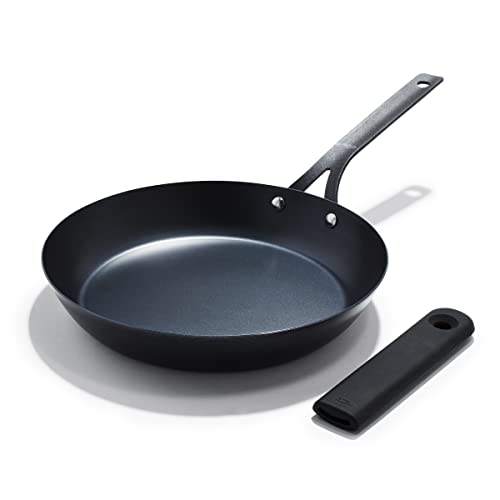
OXO Obsidian 10" Carbon Steel Frying Pan, Pre-Seasoned Skillet
10 in$57.91 Check pricePrices change often - All-Clad
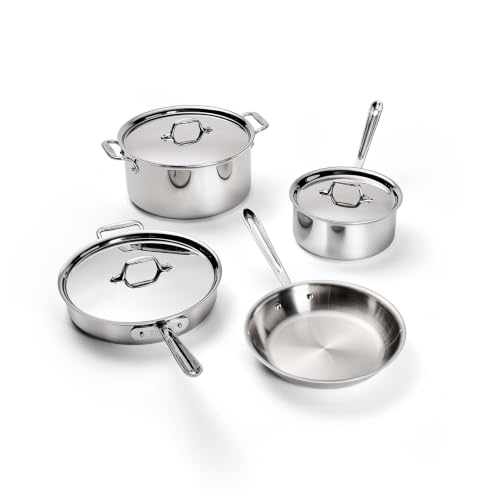
All-Clad D3 Stainless Steel Cookware Set, 7-Piece, Made in the USA
7 pieces$599.99 Check pricePrices change often - All-Clad
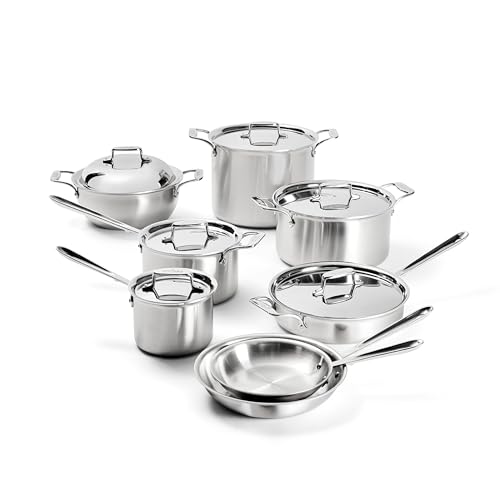
All-Clad D5 Stainless Steel 14-Piece Cooking Set, Made in the USA
14 pieces$1,499.95 Check pricePrices change often



Common questions
Why does not all stainless steel work on induction?
Stainless comes in different crystal structures. Austenitic grades such as 18/10, which is grade 304, contain enough nickel to be non-magnetic, and induction cannot couple to them. Ferritic grades such as 430 are magnetic and work. Cookware makers exploit this by putting an 18/10 cooking surface inside and a 430 layer outside, so the pan is inert where food touches it and magnetic where the hob touches it.
Does an induction interface disc work?
It works in the sense that the pan gets hot, and it throws away most of what induction is for. The disc heats up and then conducts heat into the pan, which reintroduces the lag and the uneven heating that induction removes. It is a reasonable stopgap for one irreplaceable pan and a poor basis for a whole kitchen.
Why will my hob not detect a small saucepan?
Most domestic induction rings need roughly a 4.3 inch (110 mm) magnetic base before the detection circuit registers a pan at all. Small saucepans, single-egg pans and milk pans frequently fall below that and the ring simply will not light, even though the metal is entirely correct. Some hobs have one smaller ring specifically for this.
Can I use a wok on induction?
Only a flat-bottomed one, and only if that flat area meets the minimum diameter. Induction needs the magnetic metal close to the glass, and a traditional round-bottomed wok touches at a single point. A wok ring does not help, because lifting the pan away from the surface is exactly what breaks the coupling. Some hobs offer a dedicated concave induction ring for woks.
Is the magnet test really reliable?
Yes, and it is more reliable than any label. Induction works by inducing currents in ferromagnetic metal, and a magnet sticking firmly is a direct test of that same property. A firm grip across the whole base means the pan works. A grip only in the centre means a small bonded disc, which heats unevenly. No grip means it will not work at all.