The right pan to cook rice
Quick answer
To cook rice, use a 3 quart tri-ply stainless clad saucepan. A heavy base and a well fitting lid matter more than anything else, since rice cooks on residual steam after the initial boil.
The material properties are published. Which material suits which job is reasoned from those properties and from common kitchen practice.
| Material | Conductivity | Heat retention | Reactive | Suits this job |
|---|---|---|---|---|
| Tri-ply stainless clad | 237 W/m-K | medium | No | Best choice |
| Bare cast iron | 52 W/m-K | very high, because of mass rather than conductivity | Yes | Workable, with compromises |
| Carbon steel | 50 W/m-K | medium, well below cast iron because it is much thinner | Yes | Workable, with compromises |
| Enamelled cast iron | 52 W/m-K | very high | No | Workable, with compromises |
| PTFE nonstick | 237 W/m-K | low | No | Workable, with compromises |
| Bare or anodised aluminium | 237 W/m-K | low | Yes | Workable, with compromises |
| Copper, lined | 401 W/m-K | medium | No | Workable, with compromises |
| Plain stainless steel | 16 W/m-K | low | No | Workable, with compromises |
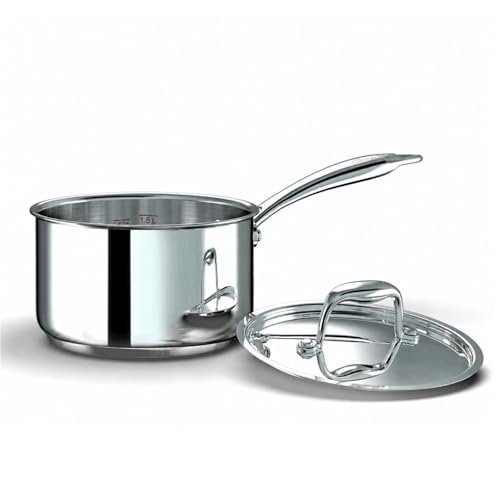
Why tri-ply stainless clad for this?
A heavy base and a well fitting lid matter more than anything else, since rice cooks on residual steam after the initial boil.
Tri-ply stainless clad conducts at about 237 W/m-K and holds heat medium. The fully clad construction is the point: the aluminium runs to the rim, so the walls heat as well as the base and nothing scorches in a ring.
Why size matters as much as material
A 3 quart vessel gives room for the contents plus the headroom that stops it boiling over. Filling a pot close to the rim guarantees a mess as soon as it foams, and it makes the pot genuinely awkward to lift when full.
Crowding is the most common way this job goes wrong. Food releases moisture, and if there is not enough surface for that moisture to evaporate it pools and the food steams at roughly the boiling point of water instead of browning. Turning the heat up does not fix it, because the limit is evaporation rate rather than energy input.
What else will work, and what it costs you
Most of the other common materials will do this job to some degree, with a specific compromise each time. A thin conductive pan responds faster and loses temperature the moment cold food lands. A thick iron pan holds temperature and is slow to react when you want to pull the heat back. A coated pan releases food reliably and cannot be run at searing temperatures. Knowing which compromise you are making is more useful than owning the theoretically perfect pan.
This material is not reactive, so there is no constraint on acidic ingredients. Induction compatibility: yes. The exterior layer is magnetic stainless, so a magnet sticks and an induction hob couples to it.
Pans to cook rice
- Farberware
Farberware Classic Series Sauce Pan with Lid, 3-Quart, Stainless Steel
3 qt$27.99 Check pricePrices change often - Sunhouse
SUNHOUSE 3 QT Stainless Steel Sauce Pan with Lid, Small Pot for Cooking
3 qt$30.99 Check pricePrices change often - Cuisinart
Cuisinart Saucepan w/Cover, Chef's-Classic Stainless Steel Cookware Collection, 3-Quart, 7193-20
3 qt$43.18 Check pricePrices change often - Tramontina
Tramontina Signature Tri-Ply Clad Stainless Steel 3-Quart Sauce Pan
3 qt$43.99 Check pricePrices change often - Tramontina
Tramontina Signature Tri-Ply Clad Stainless Steel 2-Quart Sauce Pan
2 qt$47.99 Check pricePrices change often


Common questions
What is the best pan to cook rice?
A 3 quart tri-ply stainless clad saucepan. A heavy base and a well fitting lid matter more than anything else, since rice cooks on residual steam after the initial boil. Size matters as much as material here, because crowding causes more failed results than the wrong metal does.
Can I use a different material?
Yes, with a known compromise. Tri-ply stainless clad is chosen here because a heavy base and a well fitting lid matter more than anything else, since rice cooks on residual steam after the initial boil. Other materials will cook the food safely and will change the result: a thinner pan loses heat faster, a coated one cannot be run as hot, and a reactive one limits how long acidic ingredients can cook.
What size should the pan be?
3 quarts for a typical household, with headroom so it cannot boil over.
Does this work on induction?
Yes. The exterior layer is magnetic stainless, so a magnet sticks and an induction hob couples to it. A fridge magnet on the base settles it definitively: a firm grip across the whole base means it will work, a grip only in the centre means uneven heating, and no grip means it will not heat at all.
How hot can this pan go?
The material is good to about 600F. All-Clad publishes 600F oven and broiler safe for D3. Several other tri-ply brands publish 500F, so read the pan you own rather than assuming. The real ceiling for any assembled pan is the lowest of its cooking surface, its handle and, when covered, its lid, and the handle is very often the lowest of the three.