The right pan to scramble eggs
Quick answer
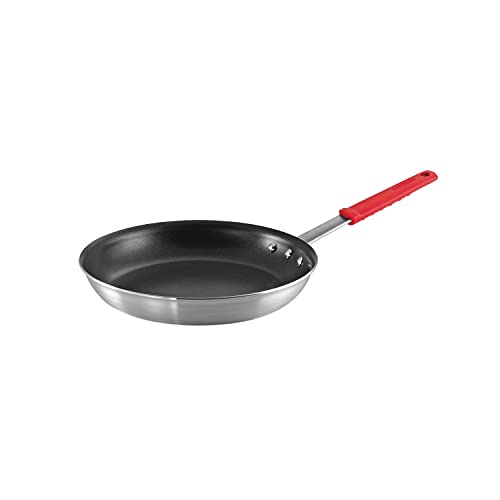
To scramble eggs, use a 10 inch ptfe nonstick skillet. Gentle heat and complete release, since scrambled eggs are ruined by sticking and by heat that cannot be pulled back quickly.
The material properties are published. Which material suits which job is reasoned from those properties and from common kitchen practice.
| Material | Conductivity | Heat retention | Reactive | Suits this job |
|---|---|---|---|---|
| Tri-ply stainless clad | 237 W/m-K | medium | No | Workable, with compromises |
| Bare cast iron | 52 W/m-K | very high, because of mass rather than conductivity | Yes | Workable, with compromises |
| Carbon steel | 50 W/m-K | medium, well below cast iron because it is much thinner | Yes | Workable, with compromises |
| Enamelled cast iron | 52 W/m-K | very high | No | Workable, with compromises |
| PTFE nonstick | 237 W/m-K | low | No | Best choice |
| Bare or anodised aluminium | 237 W/m-K | low | Yes | Workable, with compromises |
| Copper, lined | 401 W/m-K | medium | No | Workable, with compromises |
| Plain stainless steel | 16 W/m-K | low | No | Workable, with compromises |

Why ptfe nonstick for this?
Gentle heat and complete release, since scrambled eggs are ruined by sticking and by heat that cannot be pulled back quickly.
PTFE nonstick conducts at about 237 W/m-K and holds heat low. A nonstick pan is a consumable, not an heirloom. Coatings wear out with normal use, and a worn one should be replaced rather than scrubbed harder.
Why size matters as much as material
A 10 inch pan measures 10 inches across the rim and about 8 inches across the flat base, giving roughly 50 square inches of usable cooking surface. That holds about 2 seared portions without crowding.
Crowding is the most common way this job goes wrong. Food releases moisture, and if there is not enough surface for that moisture to evaporate it pools and the food steams at roughly the boiling point of water instead of browning. Turning the heat up does not fix it, because the limit is evaporation rate rather than energy input.
What else will work, and what it costs you
Most of the other common materials will do this job to some degree, with a specific compromise each time. A thin conductive pan responds faster and loses temperature the moment cold food lands. A thick iron pan holds temperature and is slow to react when you want to pull the heat back. A coated pan releases food reliably and cannot be run at searing temperatures. Knowing which compromise you are making is more useful than owning the theoretically perfect pan.
This material is not reactive, so there is no constraint on acidic ingredients. Induction compatibility: depends on the base. It depends entirely on the base. An aluminium body alone will not work; many nonstick pans have a magnetic steel plate bonded to the base specifically so they do. The magnet test is the only reliable answer.
Pans to scramble eggs
- Farberware
Farberware Cookstart DiamondMax Nonstick Frying Pan, 12.25-Inch, Aqua
12.25 in$21.99 Check pricePrices change often - CAROTE
CAROTE 12 Inch Classic Granite Non Stick Black Frying Pan, PFOA-Free
12 in$27.99 Check pricePrices change often - Tramontina
Tramontina Professional 12-Inch Non Stick Large Frying Pan
12 in$28.99 Check pricePrices change often - Blue Diamond
Blue Diamond 12" Diamond Infused Ceramic Nonstick Frying Pan Skillet, Blue
12 in$32.99 Check pricePrices change often




Common questions
What is the best pan to scramble eggs?
A 10 inch ptfe nonstick skillet. Gentle heat and complete release, since scrambled eggs are ruined by sticking and by heat that cannot be pulled back quickly. Size matters as much as material here, because crowding causes more failed results than the wrong metal does.
Can I use a different material?
Yes, with a known compromise. PTFE nonstick is chosen here because gentle heat and complete release, since scrambled eggs are ruined by sticking and by heat that cannot be pulled back quickly. Other materials will cook the food safely and will change the result: a thinner pan loses heat faster, a coated one cannot be run as hot, and a reactive one limits how long acidic ingredients can cook.
What size should the pan be?
10 inches across the rim, which gives about 50 square inches of flat cooking surface once the flared walls are accounted for. Remember a pan is measured across the rim, so the usable base is roughly 2 inches smaller.
Does this work on induction?
Depends on the base. It depends entirely on the base. An aluminium body alone will not work; many nonstick pans have a magnetic steel plate bonded to the base specifically so they do. The magnet test is the only reliable answer. A fridge magnet on the base settles it definitively: a firm grip across the whole base means it will work, a grip only in the centre means uneven heating, and no grip means it will not heat at all.
How hot can this pan go?
The material is good to about 400F. Manufacturers commonly publish 400F to 500F for oven use, and many say no broiler at all. PTFE itself begins to break down near 500F, which is why the published figures sit below that. The real ceiling for any assembled pan is the lowest of its cooking surface, its handle and, when covered, its lid, and the handle is very often the lowest of the three.