Cookware for three or four people, cooking for guests
Quick answer
Three or four people cooking cooking for guests needs about 18 pieces in total, of which 11 are actual pots and pans. That is far fewer than a boxed set advertises, because the advertised piece count includes every lid.
Which pieces earn their cupboard space is a judgement rather than a specification, and the selection rules are stated openly so you can disagree with them.
| Piece | What it is for |
|---|---|
| 10 inch skillet | The pan you reach for most. Two portions seared with room around them, or eggs and vegetables for a small household. |
| 12 inch skillet | Three or four portions at once without crowding. The size at which a skillet becomes a dinner pan rather than a breakfast pan. |
| 10 inch nonstick skillet | Eggs, pancakes and delicate fish. One nonstick pan, treated as a consumable, saves a lot of scrubbing. |
| 2 quart saucepan | Grains, sauces and reheating. The smallest pot genuinely worth owning. |
| 3 quart saucepan | Grains and vegetables for four, and the pan that stops the 2 quart boiling over. |
| 3 quart saute pan with lid | Straight sides and a lid, so it browns then braises in the same pan. The most underrated piece in any set. |
| 5 to 6 quart dutch oven | Braises, stews, beans, soup and bread. The single most capable pot in a kitchen. |
| 8 quart stockpot | Pasta, stock and large batches of soup. A disc-base pot is fine here, since only the base does any work. |
| Half sheet pan | Roasting vegetables, sheet-pan dinners, baking, and a landing place for everything else. Buy two. |
| 9 by 13 baking dish | Casseroles, baked pasta and roasting in a dish that goes to the table. |
| 8 inch chef knife | Eighty percent of all knife work. The one piece of kitchen equipment where an upgrade is felt every single day. |
| Paring knife | Peeling, trimming and anything done in the hand rather than on a board. |
| Serrated bread knife | Bread, tomatoes and cake. A serrated edge does what no chef knife can, and it never needs sharpening in practice. |
| Large wooden cutting board | A board bigger than you think you need. Cramped board space is the most common cause of slow, unsafe knife work. |
| Plastic board for raw meat | A second board that can go in the dishwasher, kept for raw meat and fish. |
| Honing rod | Realigns an edge that has rolled over. Thirty seconds a week keeps a knife feeling new for months. |
| Instant-read thermometer | The only way to know when meat is done. Cheaper than the first roast it saves. |
| Roasting pan with rack | A whole bird or a large joint. Genuinely seasonal equipment for most households. |

Why this list is shorter than a cookware set
A boxed set is priced and marketed on its piece count, so it is built to make that number as large as possible. Lids count as pieces. So do steamer inserts and plastic utensils. All-Clad D3 Stainless 10-Piece Set is one of the honest ones: ten advertised pieces made up of 6 pans and 4 lids, with nothing padding it out. Plenty of sets are not that honest.
Counting only the vessels you will genuinely reach for gives a shorter list that costs less in practice, because nothing on it is dead cupboard space. The common failure is paying for a 1 quart saucepan, an 8 inch skillet and a steamer insert that never come out.
What changes for three or four people?
Household size mainly decides pan size, not pan count. For three or four people, a 12 inch skillet becomes essential rather than optional, because four portions seared need about 100 square inches of flat cooking surface and a 12 inch pan provides 79. A larger stockpot and a second sheet pan follow from the same arithmetic.
The pieces that do not change with household size are the knives and the board. One good chef knife serves a household of one and a household of six equally well.
What cooking for guests specifically needs
Cooking for guests means everything happens at once, so the constraint is having enough pans on enough burners rather than owning any particular one. A roasting pan and a larger stockpot earn their space here, and a dish that goes to the table saves a serving step.
The organising principle at every household size and style is the same: a mixed kitchen beats a matched one. Clad stainless, one iron pan, one nonstick pan and one enamelled pot outperform four of anything, because no material is good at every job.
Cookware sets and open stock
- Tramontina
Tramontina Signature Tri-Ply Clad Stainless Steel 10-Pc Pots and Pans Set
10 pieces$329.99 Check pricePrices change often - All-Clad
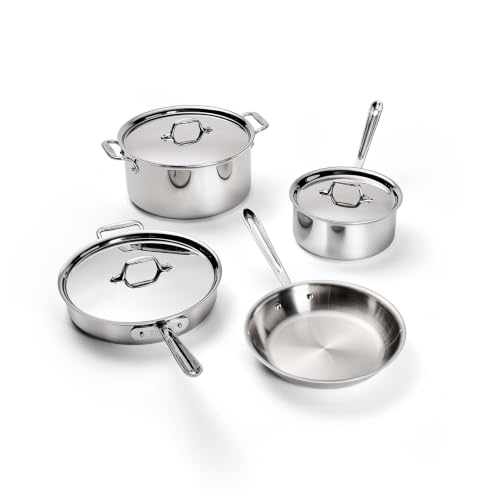
All-Clad D3 Stainless Steel Cookware Set, 7-Piece, Made in the USA
7 pieces$599.99 Check pricePrices change often - All-Clad
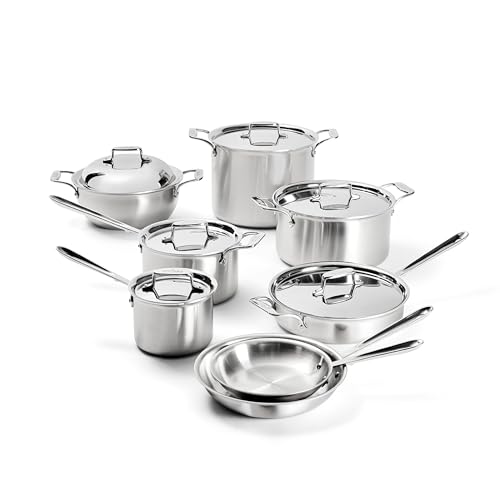
All-Clad D5 Stainless Steel 14-Piece Cooking Set, Made in the USA
14 pieces$1,499.95 Check pricePrices change often


Common questions
How many pieces of cookware does three or four people really need?
About 18 in total for cooking for guests, of which 11 are pots and pans and the rest are knives, boards and tools. That is considerably fewer than a boxed set advertises, because the advertised count includes the lids and often the utensils as well.
Is it cheaper to buy a set or individual pieces?
A set is usually cheaper per pan, and that only helps if you would have bought those particular pans anyway. Sets make sense when the vessel list matches what you cook. Open stock makes sense when it does not, which is most of the time once you know your own habits.
Should all the pans match?
No, and matching sets are the reason people assume they should. Clad stainless sears and makes pan sauces, cast iron holds heat for a crust, nonstick handles eggs, and enamel takes long acidic braises. A mixed kitchen outperforms a matched one at every budget, and the only thing lost is that the cupboard looks less tidy.
What is the piece most people are missing?
A saute pan, meaning straight sides and a lid rather than the flared walls of a skillet. It browns and then braises in the same vessel, which is what most weeknight cooking actually is, and for a given rim diameter it holds far more than a skillet because almost nothing is lost to the flare.
What should be bought first?
A chef knife and a board, before any pan. They are used in every single meal and they are the equipment whose quality is felt daily. After that, one skillet and one saucepan will cook most things, and everything else can wait until a specific meal has been difficult.