Pot size for soup for 5
Quick answer
Soup for 5 means about 7.5 quarts of finished soup, which comes to 7.5 quarts of contents. Allowing for headroom so it cannot boil over, buy a 12 quart pot. Stock in quantity, seafood boils, canning water baths.
Portion sizes and headroom allowances are kitchen conventions rather than specifications. The capacities are real; how hungry your household is, only you know.
| People | Quantity | Finished volume | With headroom | Pot to buy |
|---|---|---|---|---|
| 1 | 1.5 qt | 1.5 qt | 2.4 qt | 3 quart saucepan |
| 2 | 3 qt | 3 qt | 4.8 qt | 5 to 6 quart dutch oven |
| 3 | 4.5 qt | 4.5 qt | 7.2 qt | 8 quart stockpot |
| 4 | 6 qt | 6 qt | 9.6 qt | 12 quart stockpot |
| 5 | 7.5 qt | 7.5 qt | 12 qt | 12 quart stockpot |
| 6 | 9 qt | 9 qt | 14.4 qt | 12 quart stockpot |
| 8 | 12 qt | 12 qt | 19.2 qt | 12 quart stockpot |
| 10 | 15 qt | 15 qt | 24 qt | 12 quart stockpot |

AVACRAFT 7 Quart 18/10 Stainless Steel 4 Piece Pasta Pot Set
7 qt · 4 piecesHow much pot does soup for 5 actually need?
Soup for 5 works out at about 7.5 quarts of finished soup. That is 7.5 quarts of contents. Multiply by a headroom factor of 1.6 and you get 12 quarts, so a 12 quart pot is the size to buy.
Headroom is not padding. A pot filled close to the brim boils over the moment starch foams or a lid traps steam, and a pot filled to the rim is genuinely difficult to carry safely. The factor used here is deliberately generous, because the cost of a pot one size too large is cupboard space and the cost of one size too small is a hob to clean.
What the headroom is protecting you from
Liquids foam and climb. Simmering stock and starchy cooking liquid both throw up foam that rises well above the liquid line, and putting a lid on traps steam and pushes it higher still. A pot filled to 80 percent will find a way to boil over; one at 60 percent generally will not.
Bones and vegetables take up a surprising amount of a stockpot, so buy larger than the liquid volume alone implies.
Tall and narrow, or short and wide?
The shape decides how much evaporates. A tall, narrow pot has a small surface area relative to its volume, so contents reduce slowly and a stock stays clear. A wide pot evaporates fast, which is what you want when reducing a sauce and not what you want in a stock. For boiling, width mainly helps by putting more of the base in contact with the burner.
For this job either shape works, so choose on what else the pot will be used for.
Pots for soup
- Kirecoo
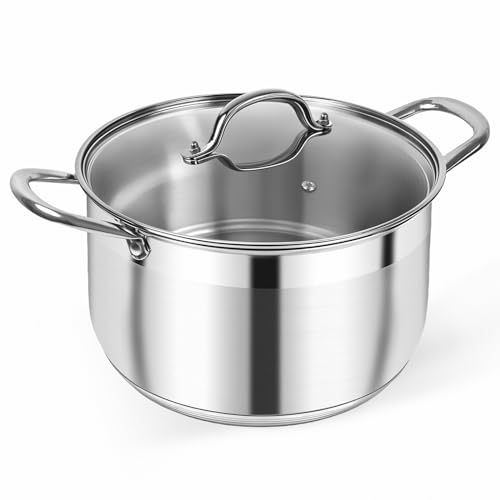
Kirecoo 8 Quart Stainless Steel Induction Stock Pot with Visible Lid
8 qt$28.99 Check pricePrices change often - SUNOUTLY
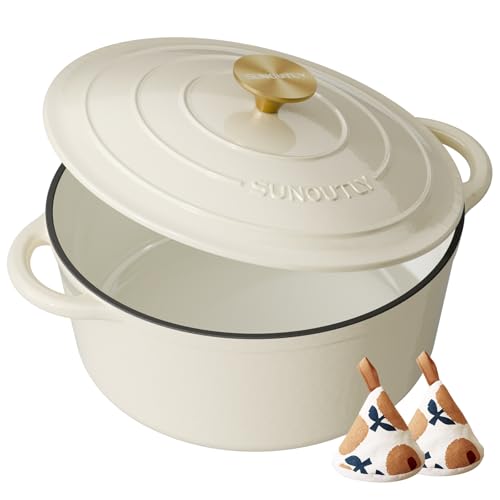
Enameled Cast Iron Dutch Oven, 6QT Pot with Lid, Cream White
6 qt$49.98 Check pricePrices change often - Cooks Standard
Cooks Standard 12 Quart Pasta Pot Set 4-Piece 18/10 (304) Stainless Steel
12 qt · 4 pieces$109.99 Check pricePrices change often - Le Creuset
Le Creuset Enameled Cast Iron Signature Deep Round Oven, 6.5 qt., Sea Salt
6.5 qt$289.95 Check pricePrices change often - Le Creuset
Le Creuset Enameled Cast Iron Round Dutch Oven, 7.25 qt., Cerise
7.25 qt$325.99 Check pricePrices change often



Common questions
What size pot do I need for soup for 5?
A 12 quart pot. Soup for 5 comes to about 7.5 quarts of contents, and multiplying by a headroom factor of 1.6 gives 12 quarts. Stock in quantity, seafood boils, canning water baths.
Why does a pot need so much empty space?
Because liquids foam and climb as they come to a boil, and a lid traps steam that pushes the level higher still. A pot filled to 80 percent will boil over at some point. Headroom also makes a full pot safe to lift and carry, which matters more as the capacity goes up and the weight follows it.
Can I use a dutch oven instead of a stockpot?
For anything up to about six quarts, usually yes and often better, because the thick walls hold heat for braises and long simmers. For large volumes and for boiling, a thin disc-base stockpot is genuinely preferable: it is much lighter to lift when full, it reaches a boil faster, and wall thickness contributes nothing when the job is boiling water.
Is a bigger pot always the safer choice?
Up to a point. A pot far larger than you need takes longer to come to temperature, is heavier empty, and is harder to store. It also heats poorly if the base is much wider than the burner. One size up from your calculation is sensible insurance; three sizes up is a cupboard problem.
Does the material matter for this?
For boiling, very little. Only the base does any work, so a cheap disc-base stainless pot performs the same as an expensive fully clad one and weighs less. Save the money for a pan where material genuinely matters.