Best chef knives
Quick answer
For most home cooks the best chef knife is the Victorinox Fibrox Pro 8 Inch at $48.04: it holds a working edge for weeks, comes back to sharp in seconds on a rod, and costs less than a dinner out.

Victorinox Fibrox Pro 8 Inch Chef's Knife, Dishwasher Safe, Black
8 inThe Victorinox Fibrox Pro 8 Inch wins on the only metric that matters for a daily knife: it stays comfortable and sharp enough to cook with, every single day, for a price that makes replacing it a non-event. Its X55CrMo14 blade runs about 55 to 56 HRC, which is soft by premium standards but exactly why it never chips and always comes back fast on a honing rod. Most people who buy a $150 knife would be happier, and richer, with this one.
The three tiers
Beginner: Best first knife
anyone who has never owned a knife worth resharpening, or who has been cutting with a dull department-store set- Beginner pick
Victorinox Fibrox Pro 8 Inch Chef's Knife, Dishwasher Safe, Black
8 in$48.04 Check pricePrices change often
The Fibrox Pro is the knife culinary schools hand new students because it forgives mistakes. The soft, tough X55CrMo14 steel at roughly 55 to 56 HRC will not chip if it clips a bone or a frozen edge, and a rolled edge comes back with ten strokes on a rod instead of a trip to a whetstone. The handle is textured rubber that stays grippy when wet, the balance point sits right at the bolster, and the blade geometry is thin enough behind the edge to cut cleanly through vegetables and proteins without wedging. At under $50 it removes the fear of ruining an expensive knife while you are still learning grip and knuckle clearance.
Not for: someone who already owns a decent knife and is looking for a genuine upgrade in edge retention or fit and finish
Intermediate: Best step up
a home cook who uses a chef knife daily and wants noticeably longer edge life plus better balance and finish- Intermediate pick
WÜSTHOF Classic 8" Chef's Knife, Black
8 in$170.00 Check pricePrices change often
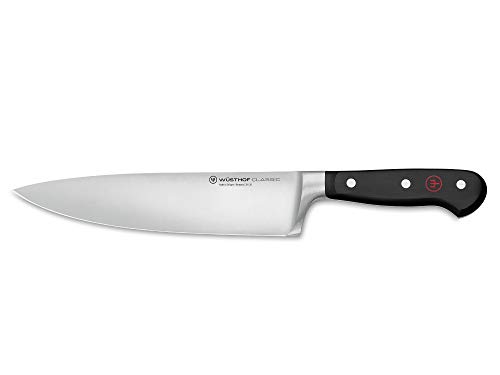
The Wusthof Classic 8 Inch moves you to forged German construction with a full bolster and a blade in X50CrMoV15 steel, which runs about 56 to 58 HRC, a meaningful step above the Fibrox Pro. That extra hardness holds a working edge longer between honings, and the heavier, forged build feels more substantial through dense vegetables like squash. The bolster also gives a pinch grip a solid stop, which matters once technique has developed past a beginner's grip. It is ground around 14 to 20 degrees per side, which is standard for German cutlery and keeps the edge durable under real kitchen use.
Not for: someone on a tight budget, since the jump in price is real and the everyday cutting performance gap versus the Fibrox Pro is smaller than the price gap suggests
Expert: Performance ceiling
an experienced cook who already sharpens on a whetstone and wants the sharpest, longest-holding edge available in an 8 inch chef knife
The Miyabi Birchwood is built around SG2 powder steel, which typically runs about 63 to 64 HRC, near the top of what any kitchen knife reaches. That hardness holds a hair-popping edge far longer than German steel, but it comes with real tradeoffs: it chips instead of rolling if it hits bone or is twisted in a cutting board groove, and a honing rod does very little for it, so it needs a whetstone to bring it back. State plainly: most people should not spend $299.95 on this. It rewards someone who already sharpens their own knives and wants the ceiling, not someone hoping a sharper knife will make them a better cook.
Not for: anyone who does not already own or want to learn a whetstone, anyone who cuts near bone regularly, and anyone for whom a chipped $300 edge would be a real disappointment
| Knife | Price | Steel | Hardness |
|---|---|---|---|
| Victorinox Fibrox Pro 8 Inch | $48.04 | X55CrMo14 | 55 to 56 HRC |
| Wusthof Classic 8 Inch | $170.00 | X50CrMoV15 | 56 to 58 HRC |
| Miyabi Birchwood SG2 8 Inch | $299.95 | SG2 powder steel | 63 to 64 HRC |
What actually makes one chef knife better than another
The two variables that matter most are steel hardness and edge geometry, and both are usually published by the manufacturer rather than something you have to guess at. Harder steel, measured on the Rockwell C scale, holds a sharp edge through more cuts before it needs attention, but it is also more brittle and more likely to chip if it twists against a bone or the edge of a glass cutting board. Softer steel dulls faster in the sense that it rolls out of alignment, but that roll is fixed in seconds on a honing rod rather than requiring an actual sharpening session.
Edge geometry, meaning the angle the blade is ground to on each side, is the other half of the equation. Modern German knives like the Wusthof Classic are typically ground around 14 to 20 degrees per side, which is a durable, forgiving angle that survives a busy kitchen. That thicker edge is part of why German knives feel like they need slightly more force to start a cut than a Japanese knife, and also why they hold up better to careless use.
Is a more expensive chef knife actually sharper out of the box
Not necessarily, and this is one of the more counterintuitive facts in cutlery. A $48 knife and a $300 knife can both leave the factory shaving-sharp, because sharpness at the factory is a function of the final polish and angle, not the steel underneath it. What the expensive steel buys you is how long that sharpness lasts and how it fails: the SG2 steel in the Miyabi Birchwood will hold that factory edge through significantly more cutting before it needs attention than the Fibrox Pro, but when it finally does lose its edge, it needs a whetstone, not a quick pass on a steel rod.
- Softer steel (about 55 to 58 HRC): dulls in the sense of rolling, fixed by honing, forgiving of mistakes
- Harder steel (about 60 to 64 HRC): holds a keen edge far longer, chips instead of rolling, needs a whetstone to recover
Why does the same knife design cost $48 in one line and $170 in another
The Fibrox Pro and the Wusthof Classic are both German-style 8 inch chef knives with similar geometry, but they differ in construction. The Fibrox Pro is stamped from a sheet of steel, which is faster and cheaper to produce and results in a lighter knife. The Wusthof Classic is forged from a single billet of steel under pressure, which produces a knife with a full tang, a pronounced bolster, and generally tighter tolerances in the fit between the blade and handle. Forging costs more in both material and labor, and that cost is passed through directly.
Neither construction method makes a knife perform meaningfully worse at cutting food. The differences show up in weight, balance, and how the knife feels over a long prep session, which is genuinely subjective and worth handling in person if you have the chance before spending $170 on a knife you might prefer lighter.
When does it make sense to buy the most expensive option
It makes sense when you already sharpen your own knives on a whetstone, you cook enough that edge retention has a real, felt impact on your week, and you are not going to be upset if a hard steel edge chips from an unlucky contact with a bone or a bowl. The Miyabi Birchwood's SG2 steel rewards exactly that person. It does not make sense as a first knife, a gift for someone who has never sharpened anything, or a purchase made on the theory that a better knife will fix a technique problem, because it will not.
How do I keep any of these knives performing like new
Hand wash and dry immediately after every use, hone before or after each session if the steel is soft enough to benefit from it, and never cut on glass, stone, or ceramic, all of which will dull an edge almost immediately regardless of how good the steel is. A blunt knife is more dangerous than a sharp one because it skates off food instead of biting into it, so staying ahead of dullness with regular honing is a safety habit as much as a performance one.
Should I buy all three tiers or just one knife
One good chef knife is enough for the vast majority of home kitchens, and the three tiers here are meant to represent three different budgets and skill levels, not three purchases for the same person. Someone who is just starting to cook should buy the Fibrox Pro and nothing else, put the money saved toward a cutting board and a honing rod, and revisit this guide only after using that knife for a year or more.
The exception is a household that already owns a capable everyday chef knife and wants a second, harder-steel knife specifically for occasions where edge retention matters more, such as breaking down a large amount of produce for canning or meal prep in one sitting. In that case the Miyabi Birchwood makes sense as a genuine second knife rather than a replacement for the first.
How we chose
This guide is researched from published manufacturer specifications, steel data sheets, and owner reports rather than in-person evaluation. Steel type and published hardness ranges tell you most of what you need to know about how a knife will behave: harder steel holds a keen edge longer but chips more readily, while softer steel rolls instead of chipping and comes back in seconds on a honing rod. Those tradeoffs, not brand names, are what separate the three tiers here.
Price, construction (stamped versus forged), bolster design, and blade geometry were weighed against how each knife is actually used in a home kitchen: daily vegetable prep, breaking down proteins, and the realistic maintenance habits most people keep. A knife that needs a whetstone every two weeks is a worse fit for someone who owns a honing rod and nothing else, no matter how good its edge is on day one.
Buying tips
Should I buy a cheap chef knife or spend more up front
If you do not already own a knife you enjoy using, buy cheap first. A $48 Victorinox Fibrox Pro will outperform a neglected $200 knife because most knife performance in a home kitchen comes from a knife actually being sharp, not from its steel chemistry. Spend more only once you know you will maintain a knife regularly, because a premium edge that is never honed or sharpened degrades to the same dullness as a cheap one, just more expensively. A good rule of thumb is to buy the maintenance tools, a honing rod at minimum, before spending extra on the knife itself, since a $48 knife kept properly honed will outcut a $150 knife left to dull in a drawer.
Does a heavier forged knife cut better than a lighter stamped one
Not automatically. Forged knives like the Wusthof Classic carry more weight near the bolster, which some cooks prefer for chopping through dense vegetables because the knife does more of the work. Stamped knives like the Fibrox Pro are lighter and faster for fine work like mincing herbs or breaking down chicken. Neither is objectively better; it is a matter of what your wrist prefers over a long prep session, and the only way to know is to handle both if you can.
How much does blade length actually matter
An 8 inch blade is the standard for a reason: it is long enough to rock through a pile of herbs or slice a squash in one pass, but short enough to control with one hand on most cutting boards. Every knife in this guide is 8 inches. Going shorter trades reach for control and going longer trades control for reach, but 8 inches is the correct default for nearly every home kitchen and the length worth learning technique on first.
Do I need to hand wash all of these
Yes, regardless of what the packaging says. A dishwasher's heat, detergent, and the knocking around inside the rack will dull an edge and can pit or discolor a blade over time, and it puts you and anyone unloading the dishwasher at risk of an unexpected edge. Hand wash, dry immediately, and store the knife somewhere the edge is not resting against other metal, such as a magnetic strip or a blade guard. This applies even to knives marketed as dishwasher safe, since that label typically refers to the handle material and corrosion resistance rather than a guarantee that the edge will survive undamaged.
Other options worth knowing about
- IGNITED CUTLERY
8 Inch Chef Knife, German Stainless Steel, Ivory White Handle
8 in$19.99 Check pricePrices change often


Common questions
Is the Victorinox Fibrox Pro really good enough for a serious home cook
Yes. It is the knife used in many professional kitchens and culinary schools specifically because its X55CrMo14 steel at 55 to 56 HRC is tough, forgiving, and easy to keep sharp with a honing rod. Serious cooking is mostly about knife skills and consistent sharpness, not steel exotica, and this knife supports both without asking for expensive maintenance.
What is the difference between honing and sharpening
Honing realigns a rolled edge using a smooth or fine rod and removes essentially no metal, taking seconds. Sharpening removes metal to create an entirely new edge, using a whetstone or similar abrasive, and takes several minutes. A knife that feels dull after weeks of use usually just needs honing; a knife that has been dull for months usually needs actual sharpening.
Can I put any of these knives in the dishwasher
No. Even knives marketed as dishwasher safe should be hand washed. The heat, harsh detergent, and jostling against other items in a dishwasher dull the edge, can discolor or pit the blade, and create a hazard for whoever unloads the rack. Hand wash and dry immediately after every use instead.
Why do Japanese knives feel sharper than German knives
Japanese double bevel knives are typically ground about 10 to 16 degrees per side, thinner than the roughly 14 to 20 degree edge on most German knives. That thinner edge slices with less resistance and feels sharper, but it is also more prone to chipping if it contacts bone or a hard surface, which is the tradeoff for that improved cutting feel.
How often should I hone versus sharpen a chef knife
For a softer steel knife like the Fibrox Pro, honing before each use or every few uses keeps the edge aligned, with a full sharpening needed only every few months depending on use. Harder steel like SG2 needs less frequent attention overall but skips honing almost entirely in favor of an occasional whetstone touch-up.
Is a full tang necessary in a good chef knife
It is a nice-to-have, not a requirement. A full tang, where the steel runs the entire length of the handle, generally improves balance and durability at the bolster end, which is why forged knives like the Wusthof Classic feature it. Stamped knives like the Fibrox Pro perform excellently without one, so do not let its absence rule out an otherwise good knife.