Best saute pans
Quick answer
The Tramontina Signature Tri-Ply Clad Stainless Steel 3-Quart Saute Pan ($57.78) is the best all-around pick, since its fully clad construction spreads heat across the wide, flat base evenly enough for browning without hot spots at the center.
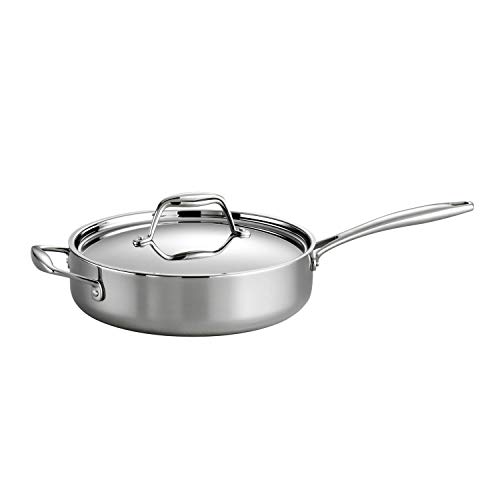
Tramontina Signature Tri-Ply Clad Stainless Steel 3-Quart Saute Pan
3 qtA saute pan's whole job is maximizing direct contact between food and a hot, flat cooking surface, so even heat across that base matters more here than in almost any other pot shape. The Tramontina Signature 3 quart saute pan is fully clad tri-ply, meaning the aluminum core runs the width of the base rather than sitting only under a small center disc, which keeps a full pan of browning chicken thighs or a wide batch of pan sauce from cooking unevenly from center to edge.
The three tiers
Beginner: Best first pot
someone who wants one wide, straight-sided pan for browning and pan sauces without paying for a premium brand- Beginner pick
Inqibee 3 QT Tri-Ply Stainless Steel Saute Pan with Lid
3 qt$32.99 Check pricePrices change often

The Inqibee 3 Quart Tri-Ply Stainless Steel Saute Pan is $32.99 and, like the more expensive options in this category, lists tri-ply construction rather than a simple stainless base, which means it has an aluminum or copper core for heat spreading even at this price point. Straight sides and a wide base are what separate a saute pan from a skillet, giving more usable flat cooking surface for browning multiple pieces of protein at once, and a lid to trap steam for finishing thicker cuts through to done.
Not for: someone doing large-batch weeknight cooking for a crowd regularly, where a lighter-gauge budget pan is more likely to warp slightly under repeated high heat than a heavier fully clad pan
Intermediate: Best value
a cook who browns meat, builds pan sauces, or cooks for four or more on a regular basis- Intermediate pick
Tramontina Signature Tri-Ply Clad Stainless Steel 3-Quart Saute Pan
3 qt$57.78 Check pricePrices change often
The Tramontina Signature Tri-Ply Clad 3-Quart Saute Pan is $57.78 with full cladding from base to sidewall, which keeps the wide cooking surface heating evenly rather than concentrating heat in the center as a disc-bottom pan would. The straight sides and flat base give more usable surface area than a similarly sized saucier or skillet with sloped sides, which matters when browning several chicken thighs or a pound of ground meat without crowding.
Not for: someone who mostly cooks single servings, since a 3 quart saute pan is sized for batch cooking and is more pan than needed for one or two portions at a time
Expert: Performance ceiling
a cook who regularly lifts a full, heavy pan of braising liquid or a large batch of risotto and wants a second handle for control- Expert pick
Cuisinart 3-Quart Saute Pan w/Helper & Cover, Stainless Steel
3 qt$74.95 Check pricePrices change often

The Cuisinart 3-Quart Saute Pan with Helper Handle and Cover is $74.95 and adds a second, smaller handle opposite the main one, which matters once a pan is loaded with a few pounds of food and liquid and needs to be lifted or carried with both hands rather than tipped awkwardly from one side. It belongs to Cuisinart's long-running stainless line, which has widely documented specs and a long owner track record for holding up to daily stovetop use over years.
Not for: someone who almost never fills the pan past a pound or two of food, since the helper handle's main benefit is control when lifting a genuinely heavy, full pan, and it adds cost without much upside for lighter everyday use
| Product | Price | Capacity | Construction |
|---|---|---|---|
| Inqibee 3 QT Tri-Ply Stainless Steel Saute Pan | $32.99 | 3 qt | Tri-ply base |
| LOLYKITCH Tri-Ply Saute Pan, 10 Inch | $35.00 | 3 qt | Tri-ply, 10 in diameter |
| Tramontina Signature Tri-Ply Clad Saute Pan | $57.78 | 3 qt | Fully clad tri-ply |
| Cuisinart Saute Pan with Helper Handle and Cover | $74.95 | 3 qt | Stainless steel, helper handle |
Why does my saute pan brown unevenly across the base?
Uneven browning across a wide, flat saute pan base is almost always a construction issue rather than a technique issue. A disc-bottom pan has its aluminum or copper heat-conducting core only under the center of the base, so the middle of the pan gets hotter faster than the edges, leaving food near the rim under-browned while the center scorches.
Fully clad construction, where the conductive core extends across the full base and up the sidewalls, spreads that heat far more evenly. This matters even more in a saute pan than in a narrower saucepan, since the whole appeal of the wide, flat shape is being able to brown several pieces of food at once with consistent results across the entire surface, not just directly over the burner.
What is the four quarts of water per pound rule and does it apply to a saute pan?
The standard rule for boiling pasta is four quarts of water per pound of dry pasta, which is really a rule for pots, not saute pans; a saute pan's straight sides and wide, shallow shape are not built to hold that volume of boiling water safely. A one pound box of pasta needs at least a 6 quart pot rather than a 3 quart saute pan, which would be at real risk of boiling over.
Where a saute pan does come into play with pasta is finishing: many recipes brown aromatics and build a sauce in the saute pan first, then add already-boiled pasta directly into that sauce to finish for a minute over heat, which is exactly the kind of two-step cooking the straight sides and flat base are designed for.
Is stainless steel or nonstick better for a saute pan?
Stainless steel is generally the better choice for a saute pan specifically because so much of its job is developing fond, the browned bits stuck to the pan bottom that get deglazed into a sauce, and a nonstick coating is designed to prevent exactly that kind of sticking. Stainless also tolerates the higher, sustained heat that searing meat calls for without the coating degradation nonstick experiences over time at high temperatures.
Nonstick has its place for delicate foods like eggs or fish that tear easily, but a dedicated nonstick skillet is usually a better fit for that job than a nonstick saute pan, since most of what makes a saute pan's straight-sided shape useful (deglazing, braising, building pan sauces) works better on a bare metal surface that browns cleanly.
Can a saute pan go from stovetop to oven?
Most fully metal saute pans with stainless or cast handles can go into the oven, which is part of why the shape is popular for recipes that sear on the stovetop and then finish covered in the oven. The detail to check is the handle material and any plastic or silicone components, since a riveted stainless handle typically tolerates full oven heat while a rubberized grip or plastic knob on the lid may carry a lower published limit.
Always check a specific product's published oven-safe temperature rather than assuming, since it varies by brand and even by line within the same brand. A lid handle or knob is frequently the lowest-rated part of an otherwise fully oven-safe pan.
This stovetop-to-oven path is exactly why a saute pan with a helper handle earns its keep for heavier dishes: sliding a fully loaded pan of braising chicken thighs into a hot oven, then pulling it back out a half hour later, is safer and steadier with two points of grip than one.
How we chose
This guide is researched from published manufacturer specifications and patterns in verified owner reviews, not from hands-on cooking or side-by-side stovetop testing. Where a listing states tri-ply or fully clad construction, a specific capacity, or a helper handle, that published detail is what is cited here, and it is noted directly whenever a spec such as induction compatibility is not explicitly listed by the manufacturer.
Preference was given to fully clad construction over disc-bottom, since a saute pan depends on even heat across a wide, flat base more than almost any other pot shape. Handle design, lid fit and whether a listing includes a helper handle for heavier loads were weighed as secondary factors within each price tier.
Buying tips
What actually separates a saute pan from a skillet or a frying pan?
A saute pan has straight, vertical sides and typically comes with a fitted lid, while a skillet or frying pan has sloped, flared sides and is usually sold without a lid. The straight sides on a saute pan let liquid build up without spilling over the way it would on a sloped skillet, which is why saute pans are the better choice for anything that starts with browning and finishes with a sauce or braising liquid added to the same pan. The flat base, shared by both shapes, is what actually delivers the direct contact needed for a good sear; the sidewall shape is what determines how much liquid the pan can hold afterward.
How much can I actually cook in a 3 quart saute pan without crowding it?
As a rough guide, a 3 quart saute pan comfortably browns around a pound and a half to two pounds of protein, such as four to six chicken thighs or a pound and a half of ground meat, without the pieces steaming each other from being packed too close. Crowding a pan drops its surface temperature quickly once food is added, since more food means more moisture releasing at once, and that moisture has to evaporate before real browning can start.
Do I need the lid that comes with a saute pan?
Yes, more than with most other pans in a kitchen. A saute pan is often used to sear something first and then finish it covered, either braising in liquid on the stovetop or steaming it through to done, and the straight sides mean a lid seals more consistently against the rim than it would on a sloped skillet. A pan sold without a lid, or with a poorly fitting one, loses a lot of the versatility that makes the shape worth owning in the first place.
Is a helper handle worth paying extra for?
A helper handle, the smaller loop-style handle opposite the main handle, earns its cost once a pan is regularly filled past two or three pounds of food and liquid combined. Lifting or carrying a full, heavy pan one-handed by only the main handle puts more strain on the wrist and makes tipping or spilling more likely, especially moving from stovetop to oven. For lighter, everyday cooking under two pounds per batch, a helper handle adds cost without much practical benefit.
Does the base diameter or the quart capacity matter more when comparing saute pans?
Both numbers describe different things and both matter. Diameter, often given in inches, describes how much flat cooking surface is available for browning multiple pieces of food side by side without crowding, which is the main job a saute pan is chosen for. Quart capacity factors in the height of the straight sidewalls, so a taller pan can hold more liquid volume for braising even at a similar diameter to a shorter pan. A cook who mostly sears and browns should weigh diameter more heavily, while a cook who regularly braises in the same pan should pay closer attention to total quart capacity.
Other options worth knowing about
- LOLYKITCH
LOLYKITCH 3-Quart Stainless Steel Sauté Pan with Lid | Tri-Ply | 10 Inch
10 in · 3 qt$35.00 Check pricePrices change often


Common questions
What size saute pan is best for a family of four?
A 3 quart saute pan is the standard size that comfortably browns enough chicken, ground meat or vegetables for four servings without crowding the pan, which would otherwise cause steaming instead of browning. Families who batch cook regularly or frequently make large one-pan meals may prefer stepping up to a 4 or 5 quart saute pan instead.
Can I use metal utensils in a stainless steel saute pan?
Yes, metal utensils are safe on bare stainless steel and will not damage the cooking surface the way they would on a nonstick coating. Stainless is chosen specifically for saute pans partly because it holds up to the scraping needed to deglaze fond from the bottom of the pan, which a metal spatula or whisk handles better than a soft silicone one.
Why does food stick to my stainless saute pan when browning?
Food sticks most often when it is added before the pan and its oil have fully preheated, or when the food is moved too soon after it hits the pan. Properly browned food naturally releases from stainless steel once a crust has formed; sticking that will not release usually resolves within a minute or two of additional cooking rather than being a permanent problem with the pan.
Is a 10 inch or a 3 quart saute pan measurement more useful?
Diameter (like 10 inches) describes the width of the cooking surface, while quart capacity describes total volume including the height of the straight sides. Two pans can share a similar diameter but hold different volumes depending on how tall the sidewalls are, so checking both numbers together gives a clearer picture of how much food a specific pan will actually hold without crowding.
Do I need both a saute pan and a stockpot?
Yes, they serve different jobs that do not overlap well. A saute pan is built for browning and pan sauces on a wide, flat surface with a small amount of liquid, while a stockpot is built to hold large volumes of water or broth for boiling pasta, making stock, or cooking soup in bulk. Trying to substitute one for the other usually means either crowding a saute pan with too much liquid or losing browning ability in a tall, narrow stockpot.